Proof by numbers
Measured from the live corpus, not estimated. Every figure below can be re-derived or challenged.
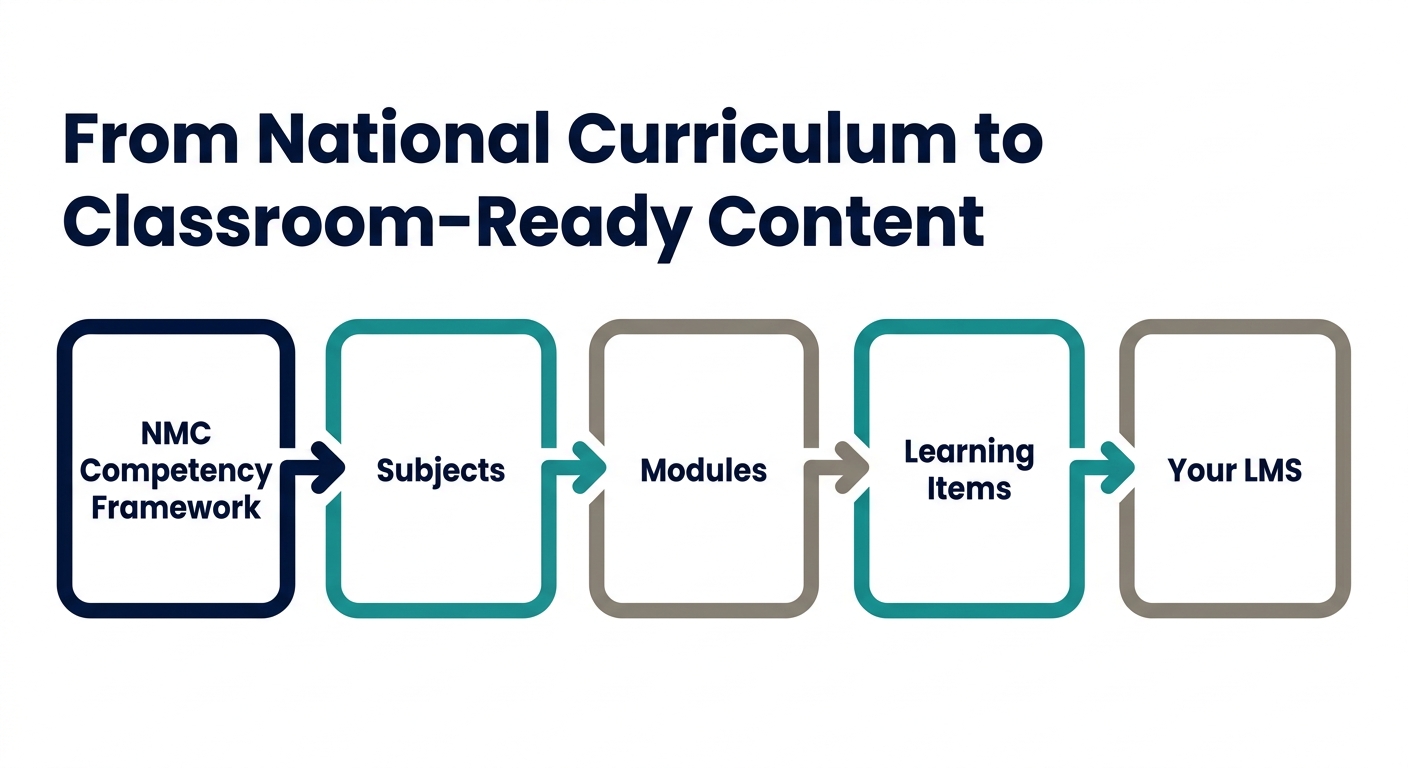
- 19 Subjects covered
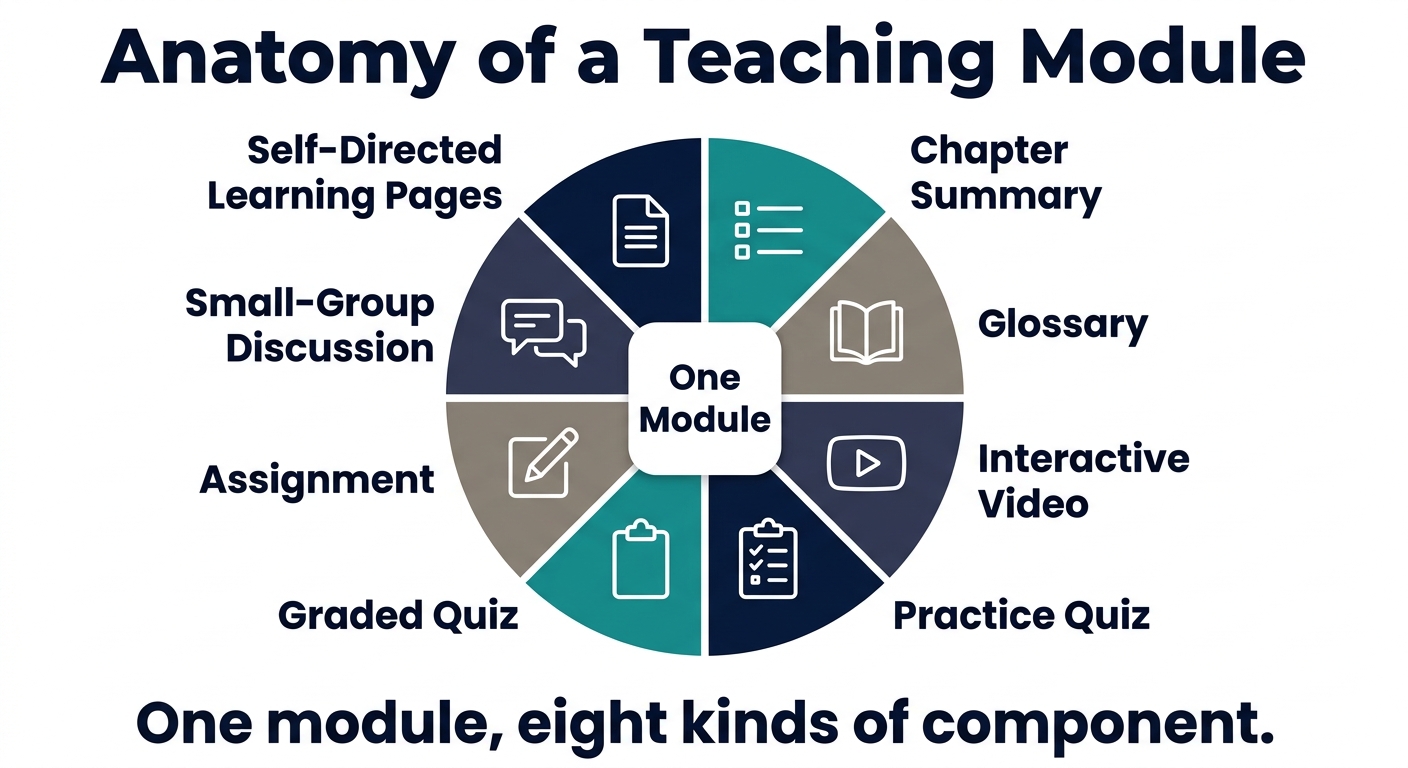
- 302 Teaching modules
- 5,978 Discrete learning items
- 10,586 Sections of written content
- 7,773 Generated illustrations
- 99.1% NMC competencies mapped — 2,600 of 2,623
Measured 21-09-2026.
The 23 competencies not yet covered are all biochemistry laboratory practicals, in a single topic: bench work performed with a pipette and an analyser. That is not a content failure; it is a category no LMS can deliver by itself. We quote the figure dated, and never round it to a hundred per cent.
What an education unit checks first
Three pillars, each of them checkable rather than asserted.
-
Authored against a named, versioned standards library
Not “modern pedagogy” as a slogan. Authoring is informed by the Academe Standards Library, a versioned, machine-readable library of named frameworks — among them Miller’s Pyramid, the Dreyfus model, Entrustable Professional Activities, CanMEDS, ACGME milestones, Bloom’s revised taxonomy, SOLO, Kern’s six-step curriculum design, Constructive Alignment, Backward Design, Deliberate Practice and Self-Determination Theory — alongside the NMC CBME framework itself.
The library informs authoring; it is not a certification. Authored against a named standards library, with provenance.
-
Competency-to-assessment alignment, by rule
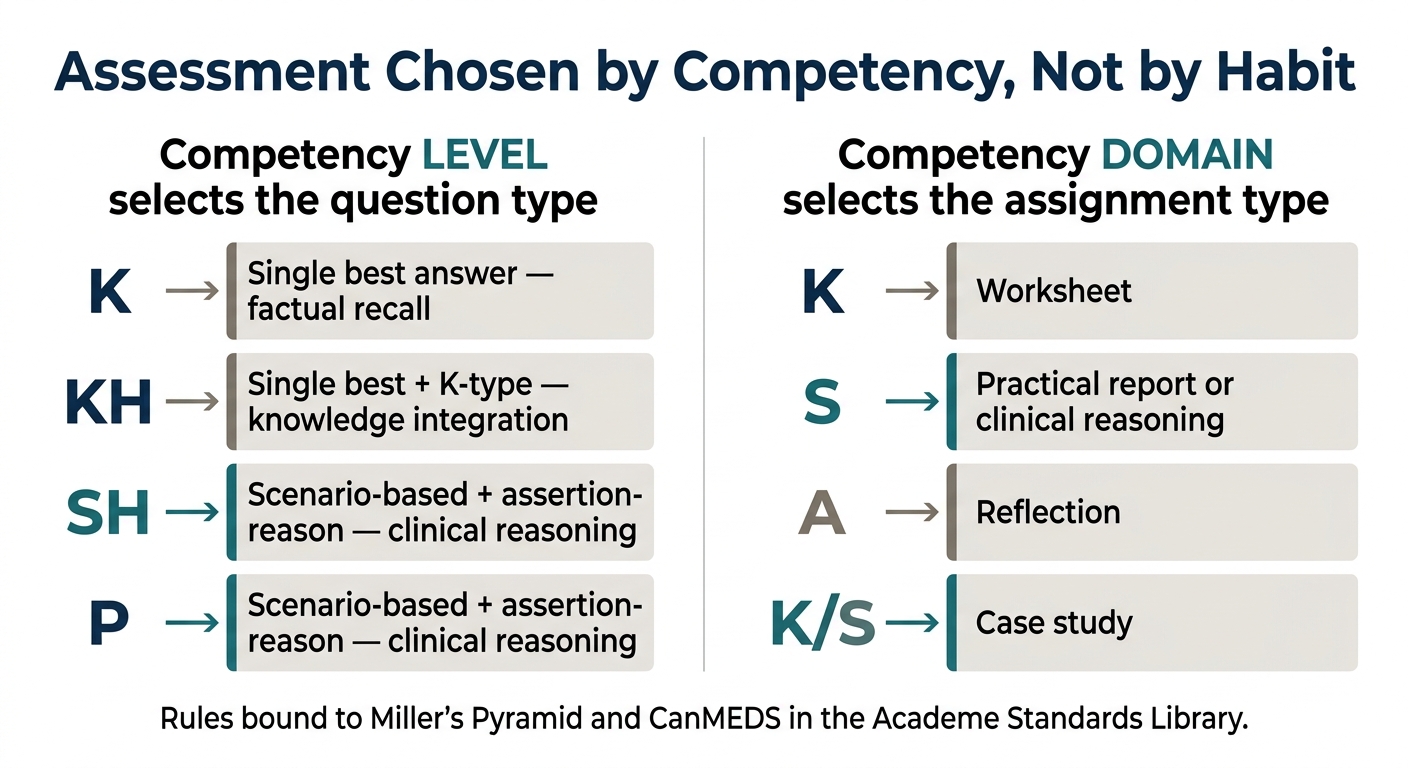
Every competency carries its NMC domain (Knowledge, Skill, Attitude) and level (Knows, Knows-How, Shows-How, Performs), and two machine-readable authoring rules turn those into the assessment, on orthogonal axes: level selects the question type, domain selects the assignment type.
Both rules are stored in the database and cite the standards they derive from — Miller’s Pyramid and CanMEDS in the Academe Standards Library.
That is the difference between “aligned to competencies” as a slogan and as a traceable chain: competency → rule → named standard.
-
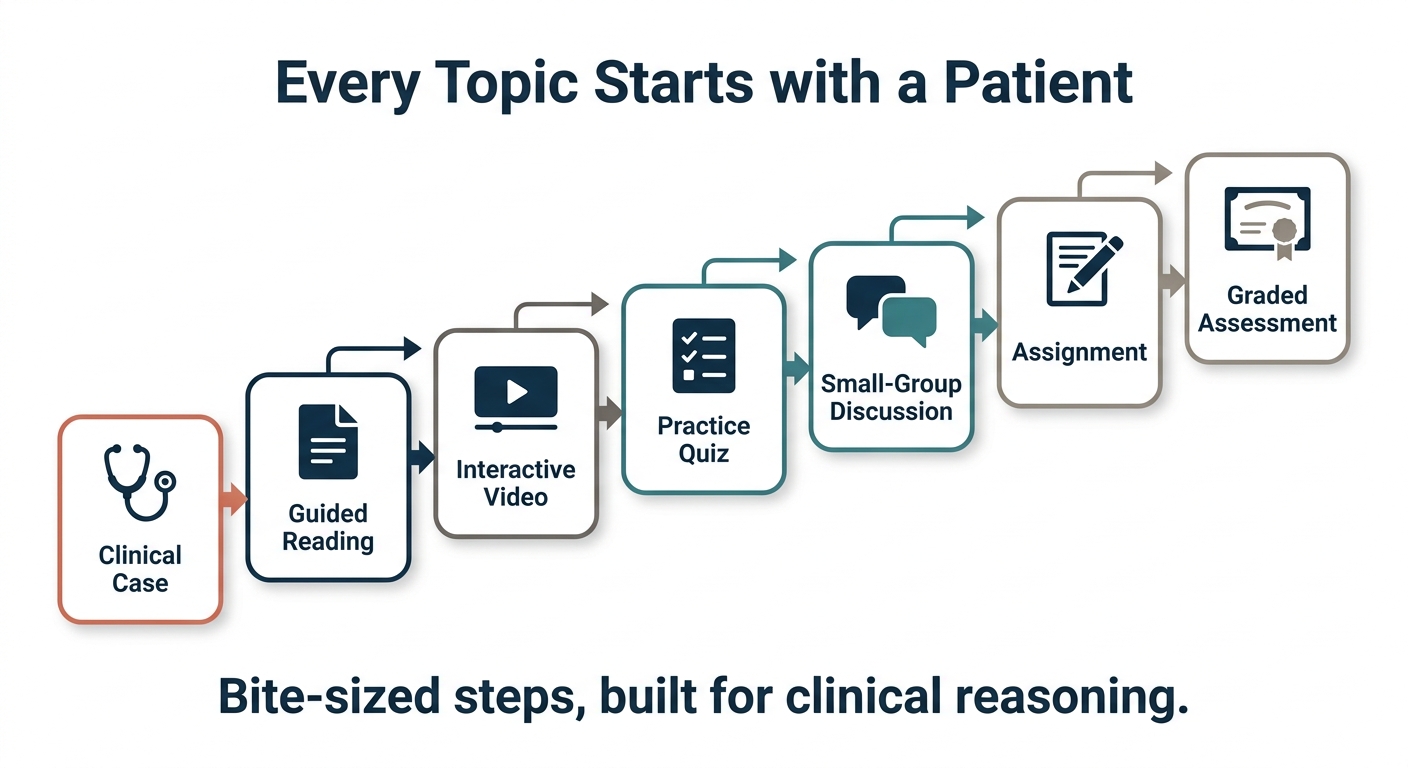
Small-group discussion delivered as structured PBL
The NMC requires small-group discussion. Rather than depending on timetabled, room-bound sessions, each module ships a staged problem-based case in the LMS discussion tool: a clinical setting, then triggers released one after another so a group works the case in sequence.
Measured, not asserted: all 302 modules carry one, each with a named clinical case and sequentially numbered triggers.
This is the pillar a Medical Education Unit head will test hardest, and it holds.
Credibility you can check from your own phone
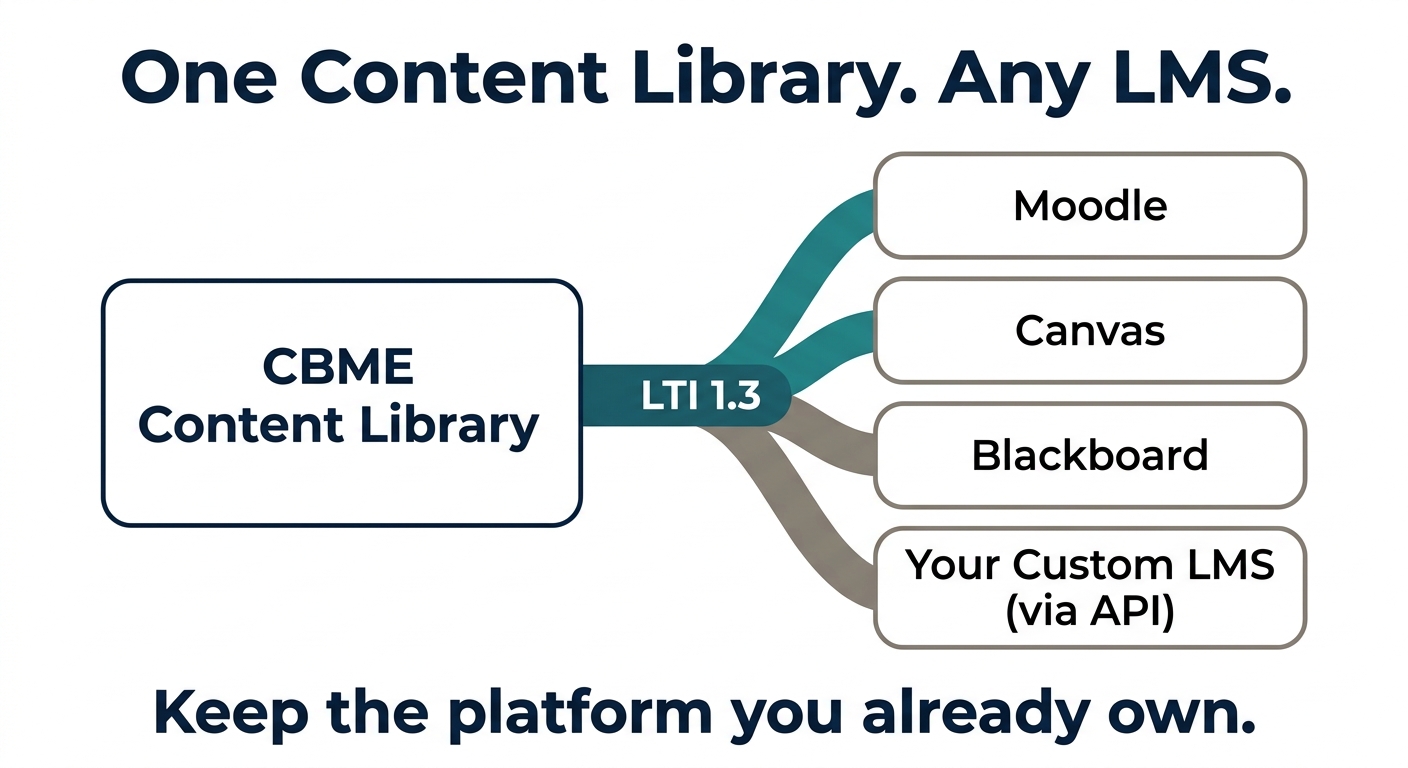
We do not name the institutions already using this platform. We borrow credibility from Canvas instead — the LMS we deploy on and promote, and the one the world’s leading universities already run.
The demo beats the statistic. Type canvas. in front of a top
university’s domain and you land on its Canvas login:
MIT · Harvard · Oxford · Princeton · Yale · Caltech · Stanford · Imperial · Chicago · Penn · Cornell · Michigan · NUS · UCLA · Johns Hopkins · Duke
Every name above can be reproduced in a browser in seconds, which is worth more than a figure you would have to take on trust.
How it fits together
The product in six diagrams.
Browse the curriculum yourself
Every subject, every module, every learning item title, open to browse.
Open the curriculum atlas